

Winter in Ohio: 5 Cold-Weather Problems for European & Asian Cars
Your Audi started fine in September, so why won’t it turn over in January? European and Asian vehicles face distinct winter challenges that catch owners off guard every year. The five problems we see most at C’s Autohaus come down to physics and engineering: batteries lose strength while your car demands more power, performance tires turn rock-hard in cold weather, manufacturer-specific fluids fail without proper winter car service, road salt corrodes precision suspension components, and temperature-sensitive sensors throw false warnings.
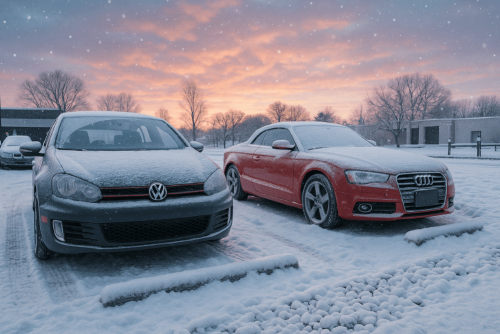
Whether you drive a Mercedes, Toyota, Volkswagen, or Honda, understanding these issues means the difference between confident winter driving and expensive tow bills. Let’s explore what makes your foreign car vulnerable and how to properly prepare it.
Why Foreign Cars React Differently to Ohio Winters
European and Asian vehicles aren’t just regular cars with fancy badges. They’re engineered with precision components, advanced electronics, and specialized systems that respond to extreme cold differently than domestic vehicles.
What makes them vulnerable:
- Advanced electronics: Complex computer systems sensitive to temperature extremes
- Specialized fluids: Manufacturer-specific requirements that can’t be substituted
- Precision engineering: Tighter tolerances that react more noticeably to cold
- Unique battery demands: Start-stop technology and extensive electrical systems
The good news? With proper preparation, your foreign vehicle can handle Ohio winters beautifully. You just need to understand what to watch for.
Problem #1 - The Battery Betrayal
Picture this: You’re running late for work on a 10-degree morning in Kettering. You turn the key, and… click, click, nothing. Welcome to winter’s most common automotive nightmare.
Why Centerville Drivers Face Battery Failures Every Winter
Cold weather creates a perfect storm for battery failure. When temperatures drop below freezing, your battery loses up to 60% of its strength while your engine simultaneously demands nearly twice the power to start.
European vehicles with start-stop technology, heated seats, and advanced climate control drain batteries faster. BMW, Audi, and Mercedes models draw power even when parked to maintain computer memory and security systems.
Warning signs you’re headed for trouble:
- Slow engine cranking that sounds labored on cold mornings
- Dimming headlights when you turn on the heater
- Dashboard warning lights appearing randomly
- Battery age exceeding three to four years
- Corrosion on terminals
Don’t gamble with battery life. A simple load test reveals whether your battery can handle winter’s demands before you’re stuck in a snow-covered parking lot.
Problem #2 - Tire Troubles That Go Beyond Tread Depth
Most drivers check tread depth and call it good. But winter tire performance involves physics that change dramatically with temperature.
The 45-Degree Rule Nobody Talks About
Here’s something surprising: summer and all-season tire rubber compounds harden below 45 degrees Fahrenheit. Even with decent tread, they lose grip significantly. Performance European and Asian vehicles often come with summer tires that become dangerously slippery in cold weather.
Cold weather tire realities:
- Pressure drops one PSI per 10-degree temperature decrease: Your properly inflated September tires are underinflated by December
- Hard rubber can’t conform to road surface: Reduces the contact patch keeping you connected
- All-season doesn’t mean all-weather: While all-season tires offer year-round convenience, they can’t match the performance of dedicated summer or winter tires. Think of them as a middle-ground solution that trades specialized performance for versatility.
Winter Tire Investment Math
Quality winter tires are an investment that extends your all-season tire life and can help you avoid costly accidents. When you consider that one insurance deductible often exceeds the cost of a winter tire set, the value becomes clear.
Worried about your tires? Schedule a free tire inspection today at C’s Autohaus, 1690 Thomas Paine Pkwy, Centerville, OH 45459, or call 937-428-6040.
Problem #3 - Fluid Failures Nobody Expects
Your vehicle contains multiple fluids working quietly behind the scenes. Cold weather exposes weaknesses in aging or incorrect fluids, often at the worst possible moment.
Critical Winter Fluids
- Engine Oil: Cold weather thickens oil, making it harder for your engine to turn over. BMW, Audi, Mercedes, and Volkswagen specify synthetic oils with particular viscosity ratings. Using wrong weights causes starting difficulties and accelerates engine wear.
- Coolant: Old coolant loses protective properties gradually. Diluted or contaminated coolant can freeze at surprisingly mild temperatures, causing catastrophic engine block damage. Visual inspection tells you nothing, proper testing reveals what’s actually protecting your engine.
Other Essential Fluids:
- Windshield washer fluid: Standard formula freezes at 32 degrees, winter-rated works below zero
- Brake fluid: Moisture contamination causes brake performance issues
- Power steering fluid: Thick, cold fluid strains pumps and makes steering difficult
Problem #4 - The Salt and Pothole Destruction Cycle
Road salt is essential for winter safety in Ohio, but it’s tough on vehicles. The salt that keeps roads passable also corrodes your undercarriage, and when combined with freeze-thaw pothole cycles, it creates the perfect storm for suspension damage.
Salt Does More Than Surface Rust
Road salt penetrates suspension joints, steering components, and brake assemblies, causing internal deterioration you can’t see until parts fail catastrophically.
High-risk components:
- Control arm bushings that crack and separate
- Ball joints developing dangerous play
- Tie rod ends loosening and affecting steering
- Shock absorbers leaking and losing damping ability
The Pothole Impact
Hit one significant pothole and you can bend wheels, blow out tires, damage struts, or knock your alignment out of spec. European vehicles with low-profile performance tires and sport-tuned suspension are especially vulnerable.
Post-pothole warning signs:
- Steering wheel off-center when driving straight
- Vehicle pulling to one side
- New clunking or rattling noises over bumps
- Steering feels loose or vague
Regular undercarriage washing removes corrosive road salt, while periodic inspections identify damaged components before they fail.
Problem #5 - Electrical Gremlins and Computer Confusion
Modern European and Asian vehicles contain sophisticated computer systems that control everything from engine management to climate control. Cold weather triggers malfunctions that frustrate owners and mechanics alike.
Temperature-Triggered Sensor Failures
Extreme cold affects sensor accuracy. Oxygen sensors throw check engine lights, wheel speed sensors cause ABS warnings, and mass airflow sensors report incorrect readings.
Common winter electrical problems:
- Check engine lights appearing mysteriously on cold mornings
- ABS or traction control warnings from temperature-sensitive sensors
- Climate control refusing to heat cabin properly
- Power windows moving sluggishly or failing completely
- Infotainment systems freezing and requiring resets
The Wiring Harness Problem
Cold makes plastic wiring insulation brittle. Harnesses crack, exposing bare wires that short intermittently when snow and salt create conductive pathways. These problems appear and disappear randomly, making diagnosis difficult without proper equipment.
Why Centerville Drivers Trust C's Autohaus for Winter Car Prep
- Digital Vehicle Inspection Systems: Photo documentation showing exactly what your vehicle needs
- Specialized winter maintenance expertise: Our technicians are trained in cold-weather diagnostics and repairs for BMW, Volkswagen, Audi, Mercedes, Honda, Toyota, and other European and Asian vehicles
- ASE-Certified Master Mechanics: Continuous training on latest European and Asian vehicle technology
- 3-year/36,000-mile Warranty: Confidence in our workmanship
As a veteran-owned, family-operated shop, we’ve built our reputation on treating customers like family and ensuring safety on the road. We offer convenient services, including after-hours drop-off and pick-up with our secure lockbox system.
FAQs About Winter Car Preparation in Ohio
How do I prepare my European car for winter in Centerville?
Start by having your battery tested, checking tire condition and pressure, inspecting all fluid levels and conditions, and examining your suspension for wear or damage. European vehicles require manufacturer-specific fluids and careful attention to their advanced systems for optimal cold-weather performance.
Why do car batteries fail in winter?
Cold temperatures reduce battery capacity by up to 60% while simultaneously increasing the power needed to start your engine. This combination, along with additional strain from heating systems and electronics, overwhelms weak batteries and causes failure during freezing weather.
What fluids are important for winter car maintenance?
Critical winter fluids include engine oil with proper cold-weather viscosity, coolant with adequate freeze protection, winter-rated windshield washer fluid, fresh brake fluid, and properly conditioned power steering fluid. Each fluid serves specific protective functions during freezing temperatures.
How to protect car suspension from snow and salt?
Regular undercarriage washing removes corrosive road salt, while periodic inspections identify damaged components before they fail. Applying protective coatings to exposed metal surfaces and replacing worn rubber bushings prevents accelerated deterioration from winter road conditions.
Should I switch to winter tires for my BMW or Audi in Ohio?
Winter tires provide superior traction below 45 degrees Fahrenheit and dramatically improve safety on snow and ice. For performance European vehicles with rear-wheel or all-wheel drive, winter tires significantly enhance control and braking compared to all-season tires during Ohio winters.
Schedule Your Winter Car Service in Centerville, OH Today
Don’t wait for the first snowstorm to discover your vehicle isn’t ready for winter. Protect your investment and ensure your family’s safety with comprehensive winter preparation from the European and Asian vehicle specialists.
Visit C’s Autohaus at 1690 Thomas Paine Pkwy, Centerville, OH 45459, or call 937-428-6040 to schedule your winter maintenance appointment. We proudly serve Centerville, Kettering, Dayton, Springboro, Beavercreek, and surrounding Ohio communities.